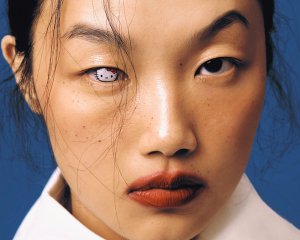
Cycle 08
Profile Story
TEXT BY Gyasi Williams Kirtley
Photography by Poyenchen
Audrey Nuna is rebuilding from the crater she made. She’s had an unbelievable 2026, and instead of there being nowhere to go but up, she’s plotting how to crash-land back into herself.
TEXT BY Gyasi Williams Kirtley
Photography by Poyenchen
Audrey wants to feel something she’s never felt before. She’s Grammy-nominated; she’s seen the world. To some, it's like she’s crossed every major accomplishment off the list. Not to her. She wants to go back to zero and dig even deeper. The playing field has reset.
Audrey isn't chasing highs anymore. She’s looking for a feeling that’s even harder to verbalize. The bitter sip of coffee that jolts you awake. That unidentifiable, hard-to-pinpoint knot in your Salomon’s that makes you walk a little more intentionally down cobblestone streets. Helter-skelter, to her, isn't chaos — it's the new equilibrium. She wants to raw-dog life so she can learn from it. At least, that's where she thinks the best art lives.
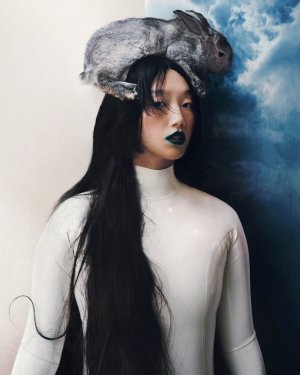
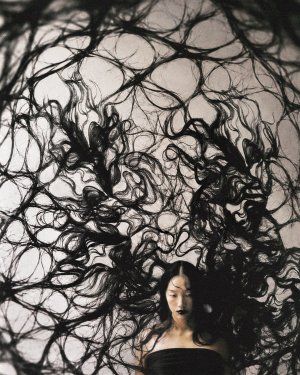
LATEX TOP - VEX LATEX SKIRT - HANNAH FREEKE
No shade to musicians today, but be honest: who's really studying music anymore? Not through a YouTube docuseries from some anonymous poster, or a Reddit thread from people who "were there" at Woodstock 99’ and now live vicariously through it, three times removed. Who's actually a student?
Audrey is, even if she’s an NYU Clive Davis Institute dropout. That's why she bends the rules like no one else… and why it sounds otherworldly.
We spoke to her about the road ahead post-K-pop Demon Hunters, embracing the uncomfortable, and how it feels to go from a DIY tour to suddenly seeing Leonardo DiCaprio more times than your local barista.
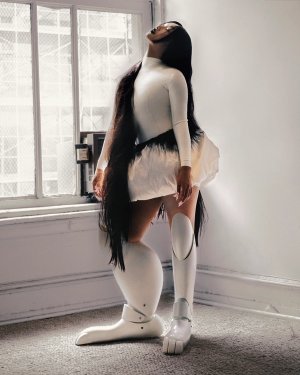
LATEX TOP - VEX LATEX SKIRT - HANNAH FREEKE
“For me, the new era has been character development.”
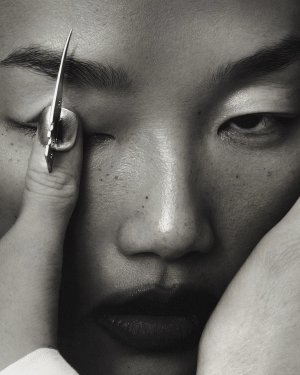
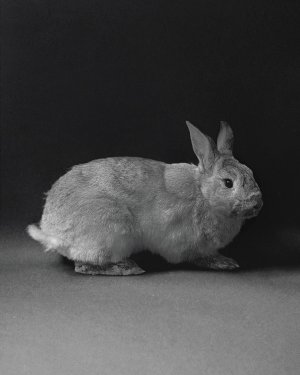
GYASI: So can you walk me through the shoot? The vibe — how you were feeling?
AUDREY: It was so fun, honestly. Shoots in New York are so different. There's a level of chaos that I think is so sick. It's truly such a creative process. It feels like a very alive process.
GYASI: Mmhm.
AUDREY: The space is so cool — the multidisciplinary, cross-disciplinary thing that 66 Green has going on was extremely inspiring to me. The photographer was nuts — loved it so much. He's so good and so ambitious. I was sweating.
GYASI: Literally?
AUDREY: Literally sweating. I wore a latex thing for something—it was my first time putting on a latex dress, and it was the funniest thing ever.
GYASI: One-of-one experience.
AUDREY: The most perfect shoot ever.
GYASI: I saw too — you took advantage of the architectural elements. You made a reel where you're fitted into one of the grooves of the bookcase, or something like that.
AUDREY: Mm-hmm. Yeah.
GYASI: Was that spur of the moment — "oh, I have an idea, let's do this"?
AUDREY: Maybe, kind of. Honestly, my manager — it was her idea. She said, "Can you fit in this thing?" And I said yeah. We were off the high of that shoot because it was just, "What about this? What about this?" I think so much of the best work comes from that level of openness.
GYASI: Right, I love that. I think you're so avant-garde—it's almost natural to you to just say, "Yes, let's do this weird, awkward thing." I'm super curious what media you're consuming that inspires you to embrace that otherness or awkwardness.
AUDREY: Good question. For some reason, media doesn't come to mind as much as walking in cities, which is very inspiring to me. I'm in London right now.
I spent the entire day walking around. There's so much you can get from normal life, especially in cities, because there's such a mix of culture and influences. It's a combination of extreme boredom — I grew up in the suburbs of Jersey and had to imagine what life beyond the suburbs is like—and at the same time, I'd visit my dad's clothing factory in New York, which was the epitome of real life in New York City. So it's this ping-pong between seeing human beings on the street. Media-wise, I really love animation. The last animation that really inspired me was Blue Eye Samurai.
GYASI: The TV show?
AUDREY: Yeah.
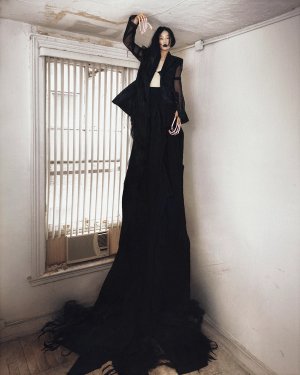
SKIRT - SKYE WILSON BLAZER - LANDEROS NEW YORK
“I want to admit some ugly truths to myself, in my art, so I can share it with others, too.”
GYASI: DUDE! They need to bring that back. They've been saying it's coming back for a really long time, and it hasn't. I'm pissed off.
AUDREY: They're dropping it January 2027. They're targeting me with the press releases, I guess, because I'm so in and it got confirmed for a third season.
GYASI: No way! Niceeee, okay, I can chill now. I rewatched it recently, earlier this year, because I thought this show was insane — literally insane.
AUDREY: Insane. I don't think people are talking about it enough.
GYASI: When you're walking around, I'm curious what your eye is capturing, because I'm obviously not in your brain. I don't think most people understand that everyone thinks and processes differently. You might see an elderly woman walking down the street in a fur coat, and I might visualize her past life story, but you might see something totally different. Our stories will be different — what we take away from that moment or observation. Are you creating scenarios in your head of what exists, based on what you're seeing in real time — people, architecture, different languages — when you're traveling abroad?
AUDREY: I think it's the fusion of everything. Even with Blue Eye Samurai — one of the reasons that show captivated me so much is the genre-bending happening. It's set in the Edo period in Japan, but the animation felt so modern.
GYASI: Hmm.
AUDREY: It gave Game of Thrones, but it also gave some of the older Korean period K-dramas I watched growing up. It gave so many different things, and that's the same thing when I walk through a city. What really mesmerizes me is seeing so many different things coexist in one space. I'm walking by a feminist bookstore, then seeing people street performing on a completely different vibe. It's the coexistence of all the things—even silly things, like the font selection of a Chinese fruit market in New York or London. Those little details capture my heart, for whatever reason.
GYASI: Mm-hmm.
AUDREY: I wish I understood my own brain, honestly.
GYASI: If you understood it, it would probably be boring — "oh my God, here's this again." With that in mind — how you're viewing the world and how the world connects to you — what elements do you bring into your music, and how do you communicate that avant-garde spirit through your music and the choices you make, especially the new music you've been working on?
AUDREY: For me, the new era has been character development. A lot of times we aspire to make the best work we can. I'm still very much in process, figuring that out—as I think we all will be, forever.
GYASI: Right.
AUDREY: I've learned harder and more challenging lessons over the past few years. I've failed more than I ever have, and I'll hopefully keep making mistakes and learning from them. I've gone through the birth and death of relationships more than ever, disappointing people, and also being part of projects that mean so much to people—a much wider spectrum of life experience. I'm not just asking myself what's happening—I've reached the end of a cycle.
GYASI: Mmhm.
AUDREY: I went through that so I could learn how to draw boundaries. I went through that so I could learn how to communicate better. Your art follows the person you are — it's not that you make your best work and then suddenly become who you're "supposed to be." So much of what's coming is going to be fed and nourished by these very human lessons I've had to ingest, whether I liked it or not.
GYASI: That's interesting. Is it more like an Ouroboros situation — you're learning, going back and forth with yourself, this continuous cycle of feeding into what you've learned, bringing that to yourself, dissecting it, implementing it, and moving on?
AUDREY: Yeah, I think so. This is random, but Jacob Collier gave a speech—I think at Berklee College of Music—about how music is one of the most incredible things to learn, because through it you learn how to listen, how to trust yourself, and how to say the things you normally can't say. A lot of the lessons I learn as a person—the studio is sometimes the ultimate test of whether I can actually practice those things.
GYASI: Whether you've actually learned it — whether it's real.
AUDREY: Exactly. You can learn something in your head, but in the studio, creating, you're naked. What you're willing to implement — and what you're not ready to implement yet — looks you straight in the face.
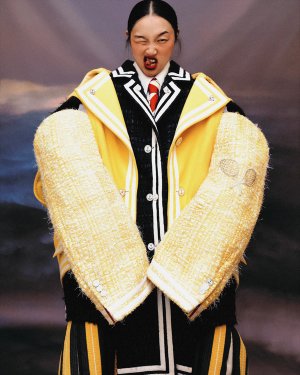
FULL LOOK - THOM BROWNE
“I’m accepting that things don’t have to make sense to be true”
GYASI: You just spoke about process and the studio environment, which is a great segue into "superhuman."
AUDREY: Your Zoom picture is dope — what's flowing in your hair, wind?
GYASI: Oh, thank you. I'm a little under the weather, so sorry you can't see my face today. I’m actually really hot.
AUDREY: It's sick. I hope I'm not getting sick too, but I feel you — that's a dope photo.
With “superHuman”, I think all the music you make is a timestamp of where you were at the time. At that time, I felt so perceived — it was during the K-pop Demon Hunters period…
GYASI: At the nexus of it all.
AUDREY: I felt like I was being portrayed as a figure, in a sense—it's strange to be around people you've only seen on television and in films. There's a bit of dissociation between the figure and who you are as a person.
GYASI: Hmm.
AUDREY: I think “superHuman” is honest in that it portrays the level of victory and triumph I was feeling, but also that sense of—this is the figure people are perceiving me as, which is such an interesting social experience. I don't think it was one specific moment [that sparked the track] as much as everything. It was shocking—I went from doing my first headline tour in a van, driving cross-country with seven other people, everyone wearing ten different hats and playing different roles just to make it work, to literally seeing Leonardo DiCaprio every five weeks.
GYASI: Yeah.
AUDREY: Not that that's the threshold for anything, but just to give context for how underground things felt before suddenly having a huge spotlight differently.
GYASI: Right.
AUDREY: It was so many things—the Grammy nominations and breaking these insane K-pop records, which I'd never done before. I'd never been involved in a K-pop project to that degree. It was the absolute shock of all of it—whether that was the more traditional award ceremony, award nomination, VMA side, or connecting with a genre that was so formative to me as a kid.
GYASI: Mmm.
AUDREY: But now, I sometimes feel a little distant from it, because the Korean American experience is quite different. I was trying to find my own way as an artist, trying to be as honest as I could, and figuring a lot of things out at the time. It was a complete processing of all of that — though I wouldn't even say it's complete, because it's still very much in process.
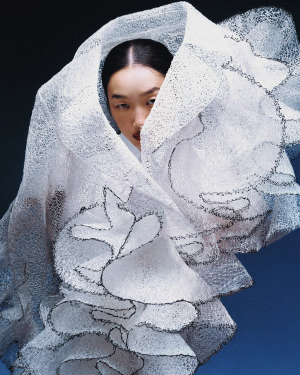
JACKET - ECLIPZ STUDIO
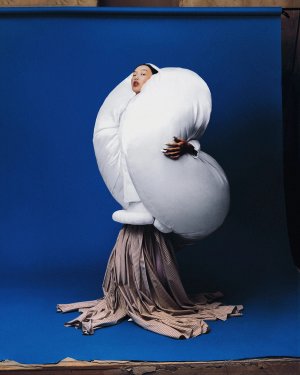
TOP - JESUS DEL REAL SKIRT - JANE WADE
GYASI: Was it like an imposter situation?
AUDREY: Good question. Honestly, I don't think it was imposter syndrome as much as being humbled in a really beautiful way and being in awe.
I grew up feeling really alienated being Korean, so it was shocking to see how far we've come in even two decades—in media and representation. Being part of the highest honor tied to that was overwhelming. As for imposter syndrome—I think everyone can feel that to some degree, but this one felt very deserved and earned for everybody involved. A long time coming, because everyone on that cast has had their experience with feeling counted out.
GYASI: Yep.
AUDREY: So it felt triumphant, overdue, and also the most perfect, serendipitous timing.
GYASI: I remember watching the moment K-pop Demon Hunters won the Grammy. I'm not Asian American, but I was bawling my eyes out. I felt the moment, even though it wasn't for me.
AUDREY: So good, I love it. It's an interesting duality to live through. Especially early in my career, I was very centered on doing what I want and expressing myself freely—who cares what anyone else thinks—and that's such an important foundation to have as an artist. But being part of K-pop Demon Hunters gave me a beautifully different experience—wanting the win for the team, and not just the team, but for the kids who'd never seen a Korean person win a Grammy, the kids who never saw themselves represented in award show spaces or in media and entertainment. We used to be those kids—me, EJ, Ray, and Maggie. We've all been there. I don't structure my entire career around trying to win Grammys, but this was a moment where I realized it's so much bigger than that, because some kid watching television that night is going to think, "I could do that."
AUDREY: That's going to be more normal now. That's the point of all of it, to me.
GYASI: Moving into this new era, now that you've reached a very large high—but it's not Mt. Kilimanjaro for you—what are your goals now? How are you setting goals? You went from almost zero to a hundred in sixty seconds—Are you letting things happen or actually checking things off a list?
AUDREY: I feel really blessed because I've gotten such a rich education in this industry—from the bottom of the mountain to the top, seeing all those viewpoints. Starting in music, I was the one emailing every single blog in 2019 trying to get my music on the smallest playlist —
GYASI: Right.
AUDREY: — and then seeing the whole journey, this side of the experience and that side, all within about seven years. It's enough to really sober up and wake up and think, "I've seen what it's like to be part of something extremely commercially and culturally successful, and I've also seen what it's like to die on your own hill, doing the eight-person van tour with 200-cap venues."
GYASI: So it's back to you.
AUDREY: I'm just back to being a student of the craft—trying to write my best songs, trying to be more honest and vulnerable than I've ever been. I want to admit some ugly truths to myself, in my art, so I can share it with others, too.
GYASI: I love that. Speaking of your songwriting—I love your songwriting. Every time I listen to something you make, I have to run it back immediately because I miss something—a transition, a detail. I feel fully fed by the work you do, and I think that's in large part the structure in which you write music. With this new era, are you leaning into your signature songwriting style or taking what you've learned in a different direction?
AUDREY: Right now, I'm in a place where feeling is so important. I'm accepting that things don't have to make sense to be true—when you surrender to that, it's a very different process than thinking your way through it. I'm feeling my way through a lot of things that aren't in the sonic realm of what I usually do and being courageous in that way. But the process of recording K-pop Demon Hunters also taught me so much about design—songs as a functional thing that serve a story. It's combining those two: the complete chaos and unpredictability of feeling through a process, but also being able to immerse yourself in it, then step away, listen, and ask — ego aside, feelings aside — is this serving the function I want it to serve?
GYASI: Mmm.
AUDREY: I'm past making music that only I'm feeling or that nobody else is feeling, or lyrics that I completely understand but nobody else knows what I'm talking about.
GYASI: Mmhm.
AUDREY: I'm over that. It's important that I feel things, but I also want to come across clearly. In this era of so much noise and so much changing around the technology of art, something we can hold onto is a song like "Golden"—everyone understanding what's being said. I think that's really powerful right now.
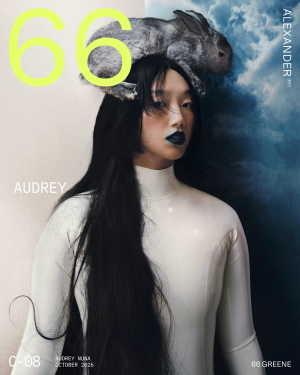
Photographer: @poyenchenz
Gaffer: @zwr_____
Photo Assistants: @Santiago.pinzon016 @walaayassien
Stylist: @jahulie
Makeup: @mitchyoshidamakeup
Hair: @akihisa0704
Nails: @Starxdnails
Rabbit Boots: @ti22_studio
Production Assistants: @dvidmattos @bellevoss_ @dovewphoto
Production Coordinator: @treboutilier
Studio Director: @snatraraps
Art Director: @dauduhh
Head Of Production: @evanmcc_
Managing Director: @jameslennonchuang
Executive Creative Director: @yohbe_
Publisher: @_by.alexander